1-5 The Interview (Part 3)

— Tabina Speaks of Tōhaku —
Visiting the Tokyo National Museum

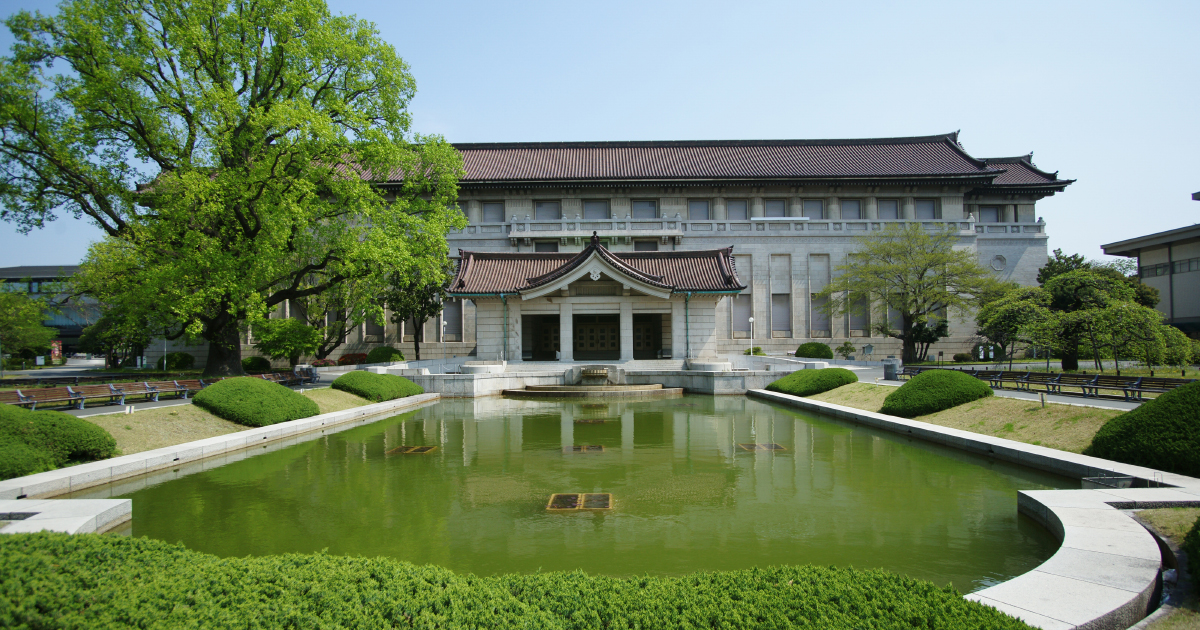
It seems many people affectionately call the Tokyo National Museum “Tōhaku.” It was my first visit, and I was amazed by its scale. With a 1,000-yen general admission ticket, you can see the permanent collections and special exhibitions in the Main Building, the Heiseikan, the Toyokan, and the Hōryūji Treasures Gallery.
I decided to start with the Main Building— the impressive structure visible directly in front of the entrance. With the clear blue sky behind it, its white walls topped with reddish-brown roof tiles felt as though they were welcoming me with strength and dignity.
Climbing the ten or so steps to the entrance, I entered the grand marble-railed hall, with its beautiful lights illuminating the staircase. In my mind I pictured a tall man, dressed like a medieval aristocrat, slowly descending the steps.
Perhaps everyone who steps into that entrance instantly senses the magnificence of the exhibits within.
Since it was early afternoon on a weekday, most of the visitors seemed to be foreigners. Several groups were taking commemorative photos with the staircase behind them.
Guidance from a Kind Stranger
The Main Building has exhibition rooms on both the first and second floors. At the entrance stood a woman wearing a card labeled “Information.” I approached her and asked:
“How should I view the exhibits?”
She smiled gently and replied:
“The second floor displays the flow of Japanese art through the ages, so it’s best to look there first. After that, you can visit the first floor, where the exhibits are arranged by theme.”
“This museum receives many visitors, and you’ll get quite tired if you try to see everything carefully. If that happens, I recommend going to the Hōryūji Treasures Gallery— it’s quiet there, and you can enjoy the exhibits calmly.”
Her explanation was so kind and precise that I was honestly surprised.
I thanked her and climbed the grand staircase.
Japanese Art Through Time
The story of Japanese art begins with the Jōmon period. The simple expressions of the clay figurines and the dynamic shapes of the flame-style pottery were so far removed from my everyday life that I could imagine nothing at all.
The standing statues of Kannon and the Buddhas from the 7th–8th centuries felt cherished, as though they had been loved and protected for generations. When I closed my eyes, I could see them swaying gently— lit by candlelight or the soft rays peeking through lattice windows.
When I saw the black armor covered in bear fur, I imagined a samurai sitting on a battlefield, a vivid vermilion scabbard at his waist, his presence strengthened by the contrast. He seemed ready to stand at any moment, eyes wide as he stared into the distance.
Then, the moment I saw the embroidered and dyed patterns on the kimono of an Edo-period warrior’s wife, all my thoughts stopped. A little girl ran past me, her furisode sleeves swaying as she trotted away. A dignified lady quietly watched from afar.
Those who wore such garments must have been filled with confidence.
As I imagined myself sitting in a tearoom with tea utensils, meeting the master of a house who gazed at ink paintings in the alcove, my thoughts came and went— and before I realized it, more than two hours had passed just viewing the second floor.
Sharing the Experience
When I finished describing this, the president said:
“I’d love to experience Tōhaku the way you did.”
Then I replied:
“I realized something while talking with you. If I knew more— like how things were made or the era they came from— I feel I could imagine even more.”
“And… I don’t have ‘the present.’”
The president looked puzzled. “What do you mean, ‘the present’?”
“I’m sorry, I can’t explain it well. But everything I saw at Tōhaku… many of those things are still loved today, and many are still being made even now. I didn’t think about that at all. The images that came to me probably came from dramas or movies.”
“My historical sense is all mixed up. It was just make-believe.”
The president looked down for a moment, thinking. Then he lifted his face, looked straight into my eyes, and said:
“It didn’t come from somewhere else. It’s your sensitivity— something only you can create.”
“When I listen to your stories, my own imagination about the exhibits expands more and more.”
“And it makes me want to know what lies beyond those thoughts.”
“That might be your gift.”
“I’ve never had such a wonderful experience.”
“Your sensitivity and imagination can surely make people happy.”
“I truly believe that.”
A warm happiness filled me, and I suddenly realized I was smiling broadly— forgetting everything else.
The next moment, tears overflowed.
An Invitation
“Tabina,” he said. “Will you come work with us?” “Will you learn about Japanese culture and traditional crafts with us?” “And will you share what you feel with many people?”
Through my tears, Heidi’s gentle smile blurred in the distance.
My mind went blank from the president’s words. After a bit more conversation, Heidi explained the formal details, and the interview came to an end.
At Sumida Park

The president and Heidi walked me out of the office and saw me off at the door.
Feeling a thrill I had never experienced before, I walked along Kaminarimon Street toward Azumabashi.
When I reached Sumida Park and gazed at the Sumida River for a while, I slowly felt myself return to who I was.
“What does it mean to share what I feel with others?”
“Can I really do that?”
“But… I want to try.”
The Sumida River continued to flow.